Wednesday, December 27, 2006

Time for reaching out

One of my favorite magazines, "The Week," takes two weeks off this time of year. I'm not sure if there is some significance to the timing or not.

As someone who used to work at trying to sell the federal government, I can testify that this is a dead time of year in that world. Most of the agencies don't have their new budgets so they don't have anything to spend.

Even President Bush is taking his time making an Iraq decision. A lot of folks are also starting in new positions so they are generally listening instead of starting new initiatives.

Traditionally this is something of a slow time of year unless you are in retail. It is a good time to step back and do a few things that might not have gotten done last year.

I hope this hiatus in our busy lives actually gives us time to enjoy what is important in life. In my mind that is our relationships with others. Our time to spend walking this earthis limited so making sure that we keep all of our circles of friendship intact is important.

This is the time of year to reach out to others and hope that they reach back. If need be, now is the time to do that apology that might be owed.

Tuesday, December 19, 2006

Winter Sun on the Southern Outer Banks

We're almost at the shortest day of the year, and we're still basking in warm temperatures. Today along North Carolina's Southern Outer Banks temperatures approached seventy degrees Fahrenheit.

It was amazing relaxing out on our deck out in the sun this afternoon. Late fall and early winter is one of my favorite times to take photos the light seems to have a golden color to it. Looking out over the pool for our subdivision towards the White Oak River, I am wondering how long it will take the sun to get to the point that is setting just opposite Raymond's Gut which runs over to the river from the subdivision Now that will be some photos worth taking.

As I'm typing, I'm listening the Jay Leno's monologue. He just mentioned the latest trend being sending family DVDs instead of family newsletters this year. I don't think I would jump on board with that trend, but I had just published 'The magical tools of our digital world" whi which talks about how powerful Apple iLife tools are for creating memories on a DVD.

It is pretty amazing the tools we have today to build memories. Our little virtual worlds touch many people, I think we'll see a continuing refinement of online communities. Maybe sharing the warmth of a late winter day will one day be as easy as pointing your video conferencing camera out the window. I'll have to get back into video conferencing, maybe the tools have matured to the point that Macs can communicate with PCs.

Sunday, December 17, 2006

The bypass conundrum

Today I got into a discussion about someone about small towns and highways. He mentioned that Hampstead, NC used to be such a nice small town until the road through down was widened to four lanes.

I started thinking about small towns that I like. It turns out that the ones on my list all made the decision to have the bypass actually bypass the town instead running the main road through the middle of town. Small towns are a delicate balance. You have to have enough life in the town to attract traffic, but there has to be enough traffic to create some life.

I am sure there are places that thought they would die if the they were by-passed. After all look what happened in "Cars" the movie, the town almost died when the Interstate by-passed it.

One of my favorite towns, is actually my home town, Mount Airy, NC. Due to geography, the town actually being on a hill, the main roads by-passed Mount Airy quiet early. Yet the downtown survived somehow and now thrives. Another good example is Lexington, Virginia which compares pretty favorably in mind to the shopping mecca of Tyson's Corner, Virginia which is built around roads. Now they aren't the same scale, but I guarantee you getting from one end of Lexington to the other is more fun that getting from one end of Tyson's to the other.

Local places in coastal North Carolina that have survived by being out of the four lane zoo include Beaufort and Swansboro.

I've lived in Columbia, Maryland, planned community, where the Mall food court ended up being the center of town. The follow-up to Columbia with lessons learned was Reston, Virginia. The Town Center of Reston is a wonderful spot assuming you can find a parking place. Of course parking isn't exactly easy in Beaufort or Swansboro. Beaufort's Front Street is at least wide enough for two vehicles which is more than you say for Swansboro, but I would not trade their quaintness for all the parking in a giant parking garage.

Four lane roads make travel easier as do by-passes. Four lane roads turn city centers in never-ending strip malls. The trouble is that by the time you figure this out and try to do the planning, it's too expensive to make it happen until something breaks.

I hope places like Mt. Airy, Lexington, Swansboro, and Beaufort continue to thrive and keep their main streets alive.

Friday, December 15, 2006

Finding their own way

I cannot find where I read it this morning, but there was a reference on rojo to a site where there was discussion on how to cool a can of soda quickly. It seems they came up with putting it in ice with salt and water and turning the can.

While this might seem like a revolution to some, anyone who has turned the crank of a White Mountain Freezer to make some homemade ice cream can tell you how well it works. I figure if you filled the ice cream container with coke instead of ice cream mix, you might make yourself some homemade slushee.

It's funny to watch a new generation "discover" things for the first time. Granted doing homemade ice cream might have been something done only in a few areas in the last few decades, but it should be part of our cultural knowledge. At fifty-seven, I don't feel that ancient, but somehow it seems part of the way we lived is being quickly forgotten.

It takes everyone some maturity before they want to learn from those who learned before them. I can remember being in my mid-twenties and wanting to know how to do some things. I was lucky to have my mom around then and until 2004. She remembered making ice cream with ice they cut from their mill pond and stored in a saw dust filled hole in the ground.

I wish she was still around there was lots that I never learned from her. We did learn how to make her fried chicken. She also schooled us in a number life's lessons. Unfortunately we can never learn all that we need to learn before our elders are gone. Well maybe our blogs will survive for a while. If my kids ever need to know how to grow tomatoes, I have it written down in a post, "The spring tomato ritual."

Who knows the way the weather is going, we might be growing tomatoes a lot earlier.

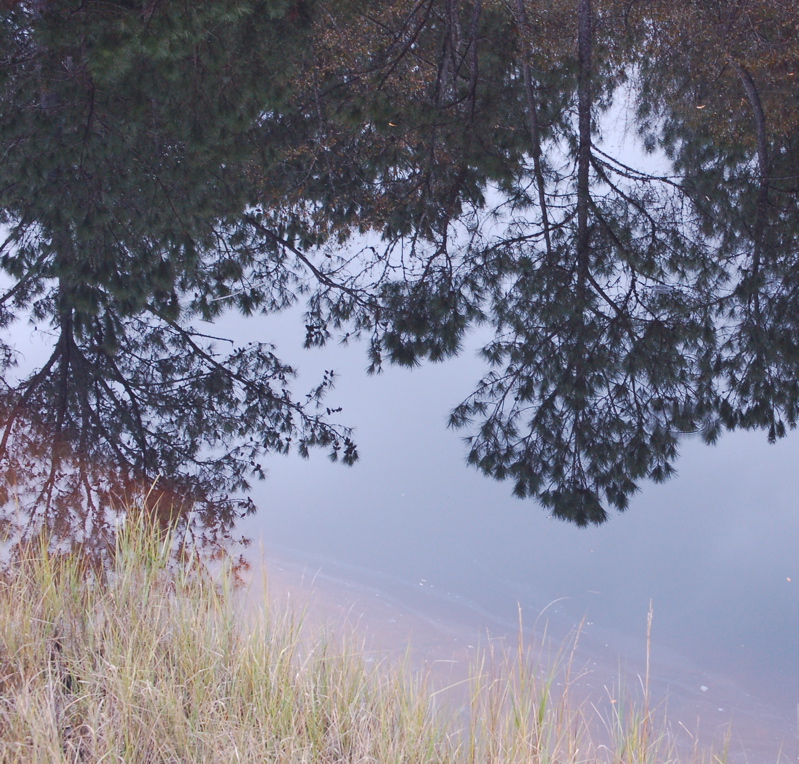
The reflection of the trees picture was taken behind our house in Bluewater Cove on NC's Crystal Coast. I have a site dedicated to interesting photos and prints that I do.

Wednesday, December 13, 2006

The glue for the modern world

Our lives continue to change. While my mother grew up in a very rural North Carolina where horses were the default mode of transportation and most people farmed. While my life has spanned 57 years, I cannot remember a time when people didn't go off to work in factories from their suburban homes.

How we connect with people has changed massively as this move off of the farm has accelerated. People used to know their neighbors well. The local stores had people who lived near you. Much of your information came from your neighbors or relatives.

As stores became larger and centralized in shopping malls, the likelihood of knowing any of the stores' employees decreased geometrically. Family and friends ended up being scattered by the demands of modern life. While there are exceptions to the rule, many people probably live in neighborhoods where they have only a passing acquaintance with their neighbors.

As this has happened, the need for locally significant information has increased greatly. Often adult children are at a distance from their parents and may actually work for companies that don't even have offices or where the necessity to work hard and socialize little has been become the norm.

Perhaps that is the explanation behind the great success of online communities like MySpace. While I believe that blogs provide a significant connection and community for some, the reality is that many bloggers might feel more community spirit with other bloggers than they do their readers.

In spite of that, much of the information and opinion provided by bloggers fills in the cracks left by the dissipation of family and friends across the country. You might not be able to get local information from mom or dad but you might be able to find answers at a local blog that you respect.

The information and guidance you can pick up from someone not trying to sell you something is well worth the effort. You can likely tell quickly how valuable the information is by the author's posts. The fact that Google and others index all this information and keep it at our finger tips makes it even more useful.

Some of our local personal relationships have disappeared only to be replaced Google's ability to recreate them by providing a virtual hook to the local area from neighboring people we have never formally met.

I have only met one of my favorite blog authors, yet I feel like I know all of them in spite of a few being anything but local.

I think you will enjoy reading Fragments from Floyd, Seans's Horse Farm and Family Blog, Loose Leaf Notes, NosceTipsum, and Leaves of Grass. My first stop if I cannot find information about Floyd on Google would be Fred, and Sean would get tapped if were looking for something in Boone's Mill.

Today you can find some virtual communities that are more formal such as the ones done by Backfence. The first done by Backfence are in California, northern Virginia, Illinois and Maryland. This areas need a lot more glue to hold them together than we do in southwest Virginia or coastal North Carolina. We still do talk to our neighbors down here.

As we have more and more online content to fill in the cracks in our information overwhelmed world, blogs provide a valuable link to others. We have a need to communicate and get information from sources that are more than just anonymous voices. Fortunately on the web, we can strive to be more than just unknown outposts of sometimes useful information.

Perhaps you should look at bloggers as lighted guideposts to find your way to your way in this very complex world when you have exhausted all of your local sources

Tuesday, December 12, 2006

An open window in mid-December

We actually had a cold streak of weather last week down here on the North Carolina coast. As I was getting ready to mount a thermometer outside one of the windows, I happened to come into my upstairs office. The sun felt like spring so I opened the window and set the thermometer in the corner. It didn't take long to come up from the downstairs temperature of sixty-five. Since I took the picture it has risen close to eighty degrees.

The challenge of keeping cool in the winter is lot easier to handle than the challenge of keeping warm. I was thinking recently of how cold I was in December during a couple of trips to NY City and Montreal.

The city streets seem to amplify the cold. Once the giant buildings get cold, it takes a lot of heat to warm them. In the winter they radiate cold while they often prevent the suns warming rays from reaching the ground. Here in the country we're more at the mercy of the weather. The large bodies of water nearby tend to moderate the temperatures, but once they get cold they also take a long time to get warm.

You often hear about how the pace of life here on the coast enables even the most harried city person to relax. Our open spaces and relaxed way of life might also ameliorate a population trend that cities seem to enhance. I read this in a post, "Bigger Cities, Fewer People," by Stephen Johnson.
Demographers now believe that the earth’s population will peak in the middle of this century, at somewhere around 8 billion people, and then start decreasing.

Cities turn out to be a driving force behind that correction. Keep in mind that we have shifted, in just two centuries, from a planet where 3 percent of people lived in cities to a planet where 50 percent of us do. When people move to cities, they have significantly fewer children for several reasons: women tend to work, birth control is more readily available, and space limitations make children an economic liability.
While we often hear about the stress that our planet is under, we rarely hear about things coming into equilibrium. One of the most interesting things that has happened this century is the reforestation of the eastern United States. According to this USGS article ninety percent of the Northeast was covered with forest in 1700. That number had dropped to thirty percent by 19oo. Today the number has recovered to eighty percent. At the same there is something of a trend in the US for people to move to low density spaces. I suspect there is another trend for some folks to move to city cores.

I wonder if any of the movement out of the cities will slow the drop in the birth rate. Perhaps the reasons for many children outside a city are no longer there. In fact the more children you have, the more trips you have to make to the city. I wonder if suburban family sizes are smaller or larger than those in the city?